Multi-Prompting is the New Multi-Tasking
26-04-03
As AI tools become more powerful and agents begin to automate entire workflows, the human role is shifting. This post explores why emotional intelligence is becoming the ultimate differentiator, and why now is a rare window to gain a real productivity edge before AI levels the playing field.
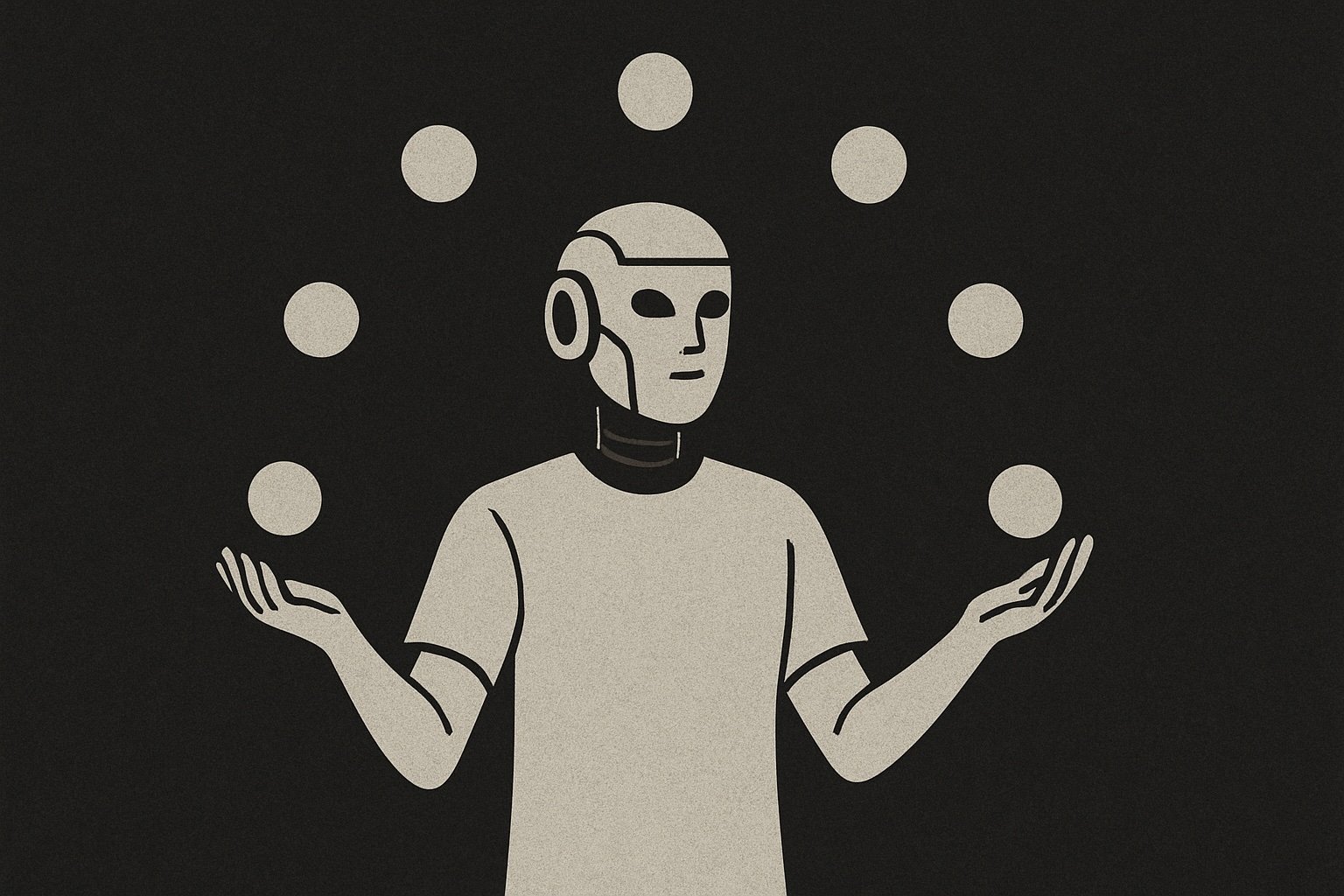
Multi-prompting is starting to feel like the new multi-tasking.
That may sound like a tautology, but it points to something real. The way we work with intelligence, human or artificial, is becoming more layered, iterative, and conversational. We are no longer just asking questions. We are building systems of thought through dialogue. Prompting is starting to feel like a form of programming.
At the same time, human connection may become more valuable, not less. The more AI simulates communication, creativity, and even companionship, the more we may value the unpredictable, messy, emotionally real experience of being human together. Emotional intelligence is not a fallback skill. It is becoming a differentiator.
The Human Bottleneck
Right now, many of us are already orchestrating small fleets of AIs: tools for writing, coding, designing, researching, and summarizing. But there is a catch. Agents can scale endlessly. The human nervous system cannot.
You can only hold so many threads in your head at once. You can only juggle so many balls before one drops. So while AI can multiply output, it can also multiply cognitive load. Every agent can generate another status update, another question, another failure mode, another branch of work that needs attention.
The CEO Agent
That is why the interface layer matters so much. The future may not be a human directly managing ten, twenty, or fifty agents. It may be a human speaking to one high-context CEO agent that understands the goal, delegates to specialists, synthesizes progress, and only escalates the decisions that actually require judgment. In that model, the human is not buried in operational chatter. The human stays focused on direction, taste, trade-offs, and meaning. Tools like Paperclip hint at that calmer orchestration layer.
As autonomous agents improve, even that coordination may recede further into the background. Instead of stringing tools together to get a result, you describe the destination and the system charts the course. Ideally, that means less cognitive stress, not more.
Trust Gets Compressed
And yet the real question is not whether something was written by AI. It is whether it resonates. Does it say something true? Does it move you? Does it matter who typed it, if it mattered when you read it?
Remember when citing Wikipedia felt risky? People cross-checked. They researched. Trust was earned more slowly. Google compressed that process into clicking one of the first results. ChatGPT compresses it further: one answer, high confidence, often no real friction. Cross-checking may slowly fade, replaced by convenience dressed up as certainty.
The Window Is Short
There is a short window right now to build real leverage with AI: better workflows, better judgment, better mental models, better taste. But that edge will not last forever. Soon, everyone will prompt. Everyone will automate. Everyone will catch up.
Until then, the advantage is not just having the tools. It is learning how to think with them.