Not your keys, not your worry
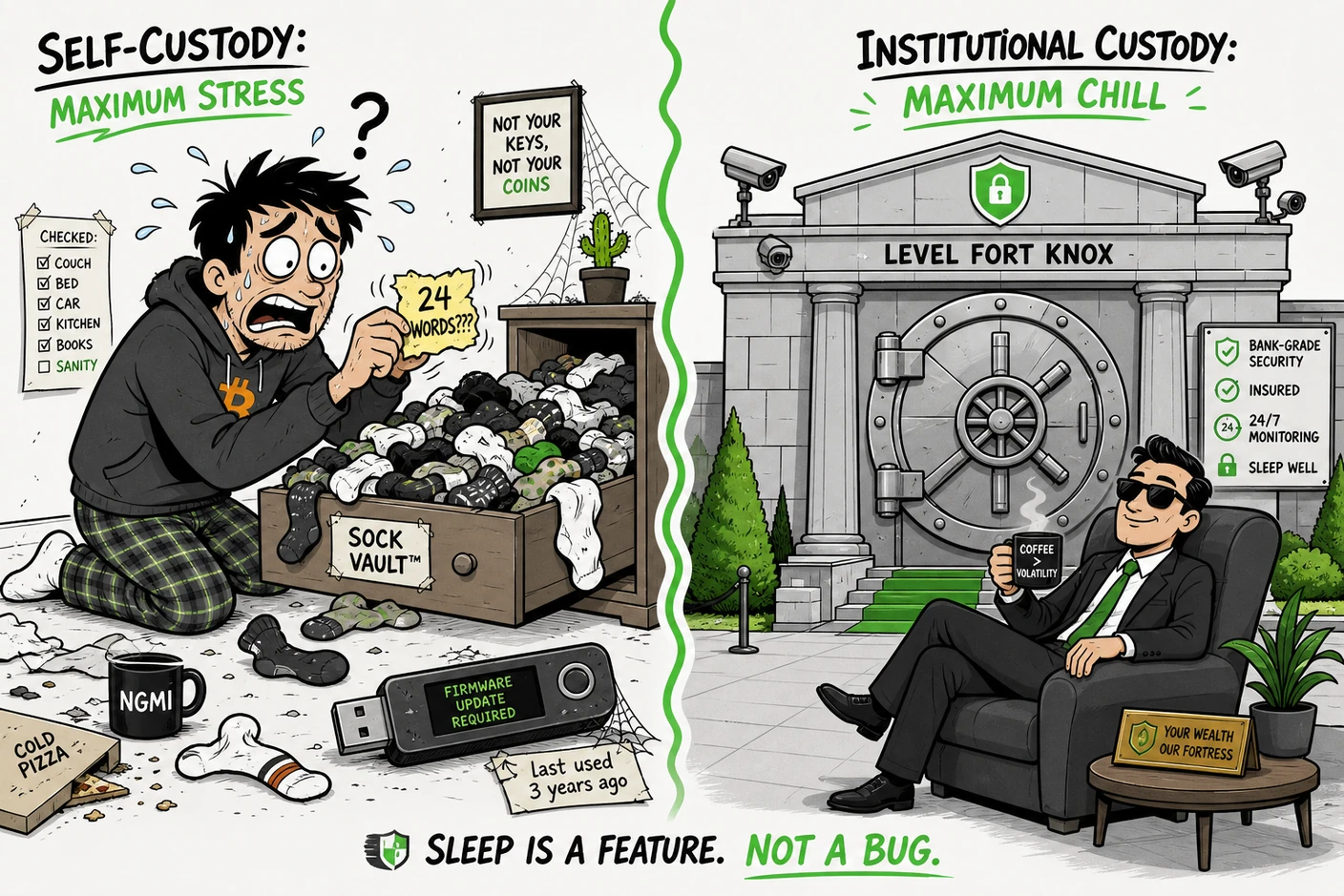
For over a decade, the most parroted phrase in crypto has been “Not your keys, not your coins.” It was a vital survival rule born in an era of wild-west exchanges, exit scams, and zero consumer safety.
But let’s be honest: the dogmatic obsession with self-custody doesn’t hold true so much anymore, especially if you are purely an investor who has no interest in messing around with DeFi and doesn’t fear other governmental risks like asset freezes, confiscation, or capital controls.
With the final MiCA (Markets in Crypto-Assets) transitional deadline hitting on July 1st, the entire structural risk of holding crypto in Europe has shifted. It’s time to rethink the stress of self-custody.
Institutional Tech vs. A Piece of Paper
Let’s look at the absolute absurdity of the current self-custody standard. We are building up life-changing digital wealth, and the industry’s best solution is telling us to stamp 24 words onto a metal plate or write them on a piece of paper hidden in a sock drawer or a home vault. How crazy is that?
The reality is simple: Tier-1 exchanges like Kraken, Coinbase, and Bitpanda deploy a much more sophisticated security setup than you or I will ever have. They use institutional-grade cryptographic multi-sig frameworks, physical hardware security modules (HSMs), and round-the-clock cyber-defense teams. Under MiCA, these platforms are legally mandated to have ironclad digital defenses, segregated client accounts, and heavy backup capital to insulate you from loss. They are built to employ much better security than an individual human managing a piece of plastic or metal.
Real Peace of Mind
If you are treating Bitcoin like a long-term asset, similar to holding Apple or Microsoft stock, centralized, regulated custody gives you actual peace of mind:
- No Fear of the Freeze: If your funds come from reputable, clean sources and you’ve completed standard KYC, you don’t need to fear anything. The compliance process is straightforward for regular investors.
- No Fragile Single Point of Failure: You don’t need to worry about losing the sheet of paper your seed phrase is scribbled on, or about having to run firmware updates on a device before you can even send your crypto, because the last time you touched it was 3 years ago. And if counterparty risk still keeps you up at night, you can simply spread your holdings across three or more different MiCA-regulated exchanges. Regulated custody removes that anxiety entirely.
- The Inheritance Problem, Solved: If you pass away unexpectedly, trying to teach your kids or spouse how to recover a hidden seed phrase without losing the funds to a mistake is a nightmare. With a MiCA-regulated platform, inheritance mirrors traditional finance. Your family can access and inherit your wealth via standard legal probate and court documents.
The July 1st Deadline: What You Need to Do
With the massive regulatory shift taking place on July 1st, here is your exact playbook depending on where your funds sit right now:
If your funds are in self-custody (Ledger, Trezor, etc.)
Do nothing. There is absolutely no need to rush your funds onto a MiCA-regulated exchange. Self-custody remains completely legal and outside the regulatory perimeter. Your coins are perfectly safe where they are.
If your funds are on an UNREGULATED offshore exchange
You need to move them immediately. Unlicensed platforms are about to face severe domain blocks and restrictions.
- Migrate your assets over to a fully compliant platform like Coinbase, Kraken, or Bitpanda.
- Convert non-supported assets: MiCA enforces incredibly strict rules on stablecoins. Non-compliant stablecoins (like USDT) are facing aggressive restrictions and delistings across Europe. Before you move, swap non-supported currencies into fully MiCA-compliant stablecoins, like converting your USDT to USDC.
If you want the peace of mind of a traditional stock portfolio without the constant paranoia of managing your own cryptographic keys, letting a fully regulated EU platform carry the security burden is no longer a compromise, it’s just smart investing.
The Bottom Line
None of this means “Not your keys, not your coins” is dead. It was the right rule for its time, and for plenty of people it still is. If you actively use DeFi, value censorship resistance and financial privacy, live under an unstable government, or genuinely fear a government freezing or confiscating your assets, then self-custody isn’t paranoia, it’s the entire point of crypto. Keep holding your own keys.
But for the vast majority, those who simply want exposure to Bitcoin the way you’d hold Apple or Microsoft stock, that threat model just doesn’t apply. We’re not dissidents dodging capital controls; we’re long-term investors who want our wealth to be secure, inheritable, and recoverable without a single sheet of paper standing between our family and a lifetime of savings.
The slogan deserves an update: not your keys, not your worry. Pick the model that fits your threat profile, not the one a decade-old meme says you’re supposed to have.
What is MiCA?
MiCA (Markets in Crypto-Assets) is the European Union’s comprehensive regulatory framework for crypto, with its final transitional deadline landing on July 1st. It forces exchanges and custodians to operate like serious financial institutions rather than wild-west startups. In practice that means a few concrete protections for you:
- Security & operational resilience: Licensed platforms must run audited custody systems, hold capital buffers, and report incidents, with ongoing supervision from EU regulators.
- Segregation of funds: Your assets must be kept separate from the company’s own balance sheet, so your coins are ring-fenced and protected even if the exchange itself goes under.
- The Travel Rule: Identifying information must travel alongside transfers between providers, the same anti-money-laundering standard that underpins traditional banking.
It also imposes tight rules on stablecoins, which is exactly why non-compliant tokens like USDT are being restricted across Europe.