My Chat Window Is My Operating System
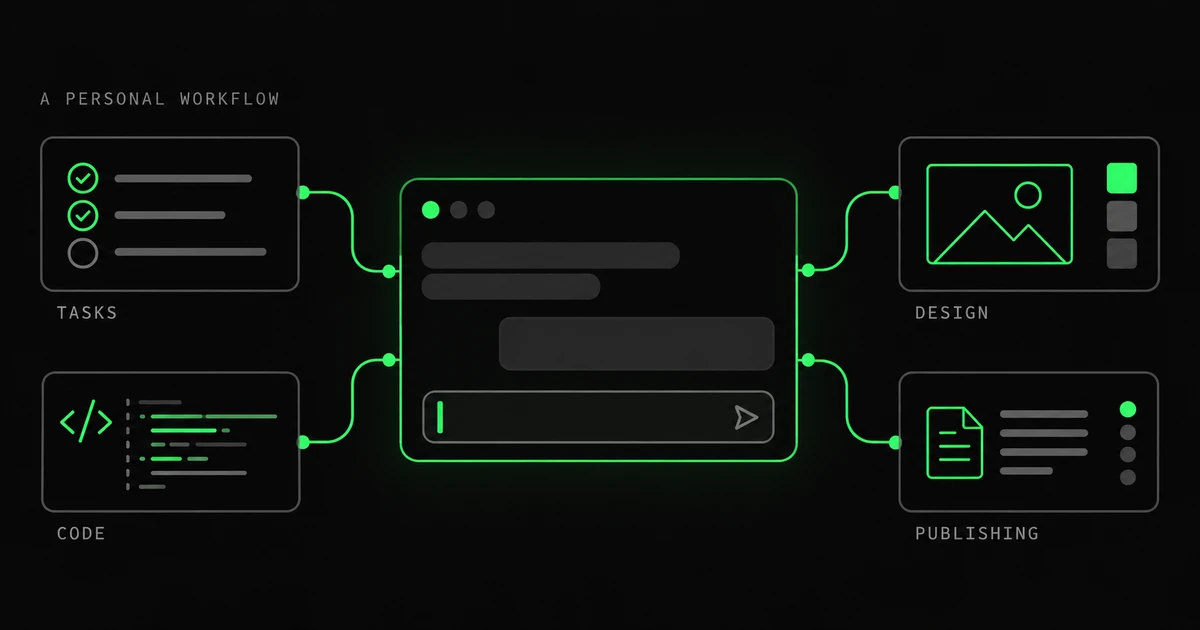
I’m currently working on several projects simultaneously. Different products, different audiences, different challenges. A few years ago, this would have required a small team of designers, engineers, marketers, and other specialists.
Today, much of it happens inside a chat window.
And I’m still surprised by how much this has changed the way I work.
Everything connects
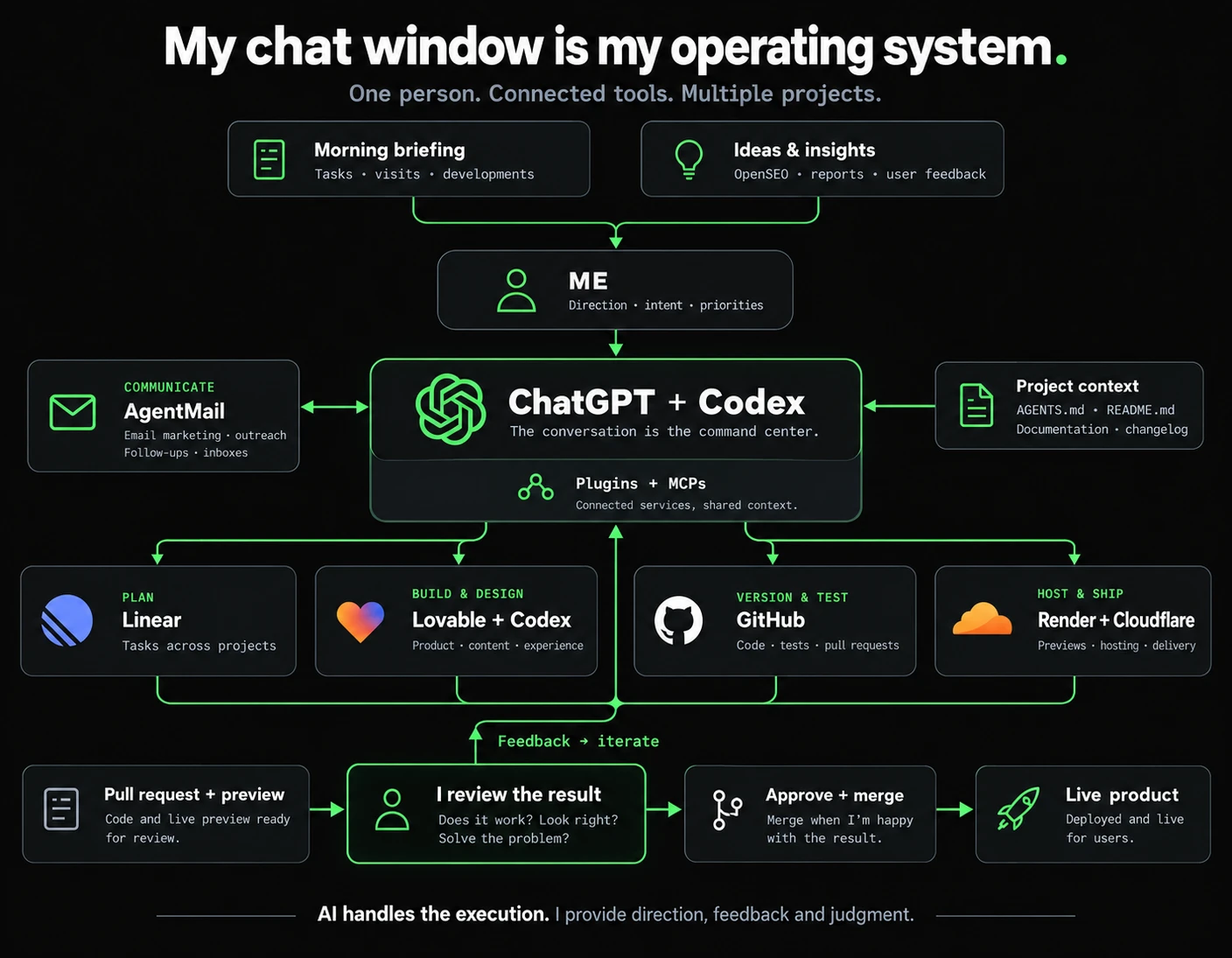
I manage tasks across my projects in Linear. I build and host with tools like Lovable, Render, and Cloudflare. GitHub handles the code, while ChatGPT and Codex have become the central interfaces through which I work.
The important part isn’t any individual tool. It’s that they’re connected through Plugins and MCPs.
I rarely need to open these services and click around anymore. I can ask what’s happening, decide what needs to change, and have the necessary work carried out directly from a conversation.
Every morning, an automated routine gives me a summary of my projects: outstanding tasks, website visits, recent developments, and sometimes suggestions for improvements based on its own analysis.
It’s a surprisingly effective way to start the day. Instead of collecting information from a dozen places, I can immediately focus on what matters.
From writing code to judging results
A year ago, reviewing AI-generated code felt essential. Today, I barely look at it.
Each project has its own AGENTS.md, README.md, documentation, and changelog. These give the AI instructions and context, and it keeps the relevant files updated as the project evolves.
I describe what I want, the AI implements it, runs tests, and opens a pull request. For more complex changes, I review the result. For simpler ones, I might just type “merge.”
My involvement has shifted from inspecting implementation details to evaluating what actually comes out.
Does it work? Does it look right? Is it intuitive? Does it solve the problem?
And if it doesn’t, I keep talking to the AI until it does.
This isn’t just about producing code faster. It’s about creating an entire experience, including design, content, functionality, and all the little details that make a product feel polished.
A team of one (sort of)
One example is Scholaris.at, a platform for designing and ordering personalized school clothing, which I’m building with a friend.
Traditionally, a project like this would need a designer, engineer, content creator, marketer, and someone who understands e-commerce.
Today, I can cover much of that through my setup. AI analyzes, suggests, designs, writes, implements, tests, and publishes. I provide direction, feedback, and judgment.
The result isn’t just that I ship faster. The quality of what I can produce, both visually and technically, has never been better. And when users provide feedback, I can act on it almost immediately.
Another interesting example is wahl.de, which I’m building with my friend Klas.
We aren’t engineers. We’re both product people.
Klas uses Cursor, Pi, and local LLMs. I use Codex, ChatGPT, OpenSEO, and other tools. We work against the same GitHub repository, build features independently, and share previews.
Then we get on the phone, discuss what we’re seeing, provide feedback, and tell our respective AIs what to change. Eventually, someone says “merge.”
In a way, we’re the glue connecting two different AI setups.
It sounds slightly absurd, but it works remarkably well.
The new bottleneck is me
There’s an unexpected downside to all this.
AI doesn’t seem to have much trouble working across multiple projects. I do.
Previously, implementing something took time. There were natural pauses while writing code, figuring things out, or waiting for other people.
Now, answers and implementations arrive almost instantly. There’s always something new to review, another decision to make, another improvement to request.
I’ve noticed that this can be more exhausting than working manually. Not because the work is necessarily harder, but because the pace rarely slows down.
So I’ve learned to take breaks. Go outside. Touch grass.
There are other limitations, of course. Token costs can add up, and services without proper MCP integrations still create unnecessary friction. But these increasingly feel like solvable problems.
The more fundamental constraint is how much attention and judgment I can provide.
Building is becoming something else
I don’t think everyone needs to adopt my exact setup.
If you’re just getting started, try something like Lovable and see what you can create. If you’re more comfortable with technical tools, connect ChatGPT or Codex to GitHub, your hosting provider, and the services you already use.
The specific tools matter less than the ability to connect them and build a workflow around how you think.
What fascinates me most is how quickly the nature of building products is changing.
A year ago, I cared a lot about the code AI was generating. Today, I care far more about the experience it creates. I expect the need to inspect code personally to diminish even further.
The bottleneck is shifting from implementation to deciding what to build, communicating intent, and judging the outcome.
And increasingly, my job isn’t to operate a dozen different tools.
It’s to have a conversation about what should happen next.