The shrinking of critical thinking
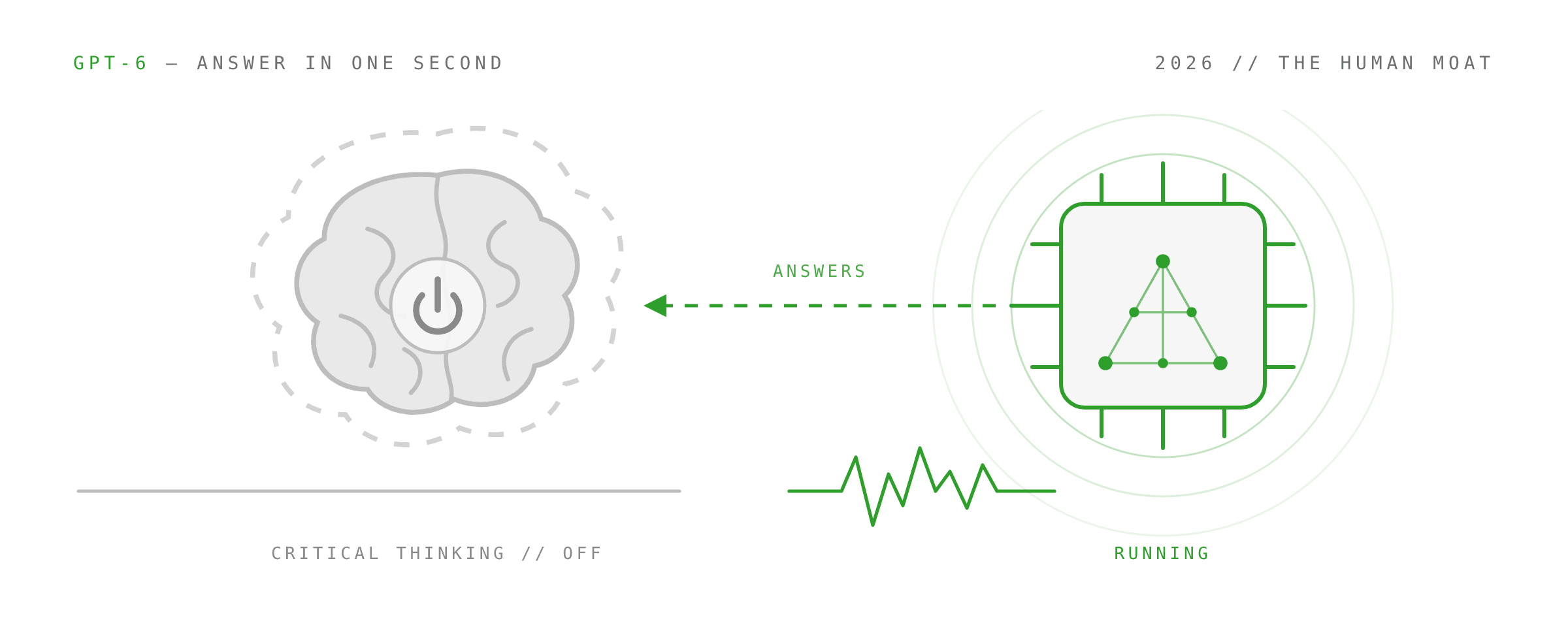
GPT-6 is out. Whether you call it AGI or “not quite yet” mostly depends on which definition you were holding when it landed, and everyone has quietly moved their definition at least twice. What is harder to argue about is the feeling in the room: the last few obvious human advantages got much thinner in a single release cycle. GPT-6 scores 95 percent on ARC-AGI-2, where the average human scores 66. On ARC-AGI-3, which tests whether an agent can work out hidden rules by playing, it scores 62.7 and the next best model manages 30.2. (leaderboards: ARC-AGI-2, ARC-AGI-3)
I keep coming back to one question, and it is not a technical one.
–
TLDR: GPT-6 makes building almost free, which means building is no longer the moat. What gets scarce is the stuff upstream and downstream of the model: knowing what is worth making, judging whether the answer is actually good, and being the one who carries the consequences. I am genuinely worried about what happens to a generation that never has to sit with a hard problem, and at the same time this is the most empowering tool I have ever had. Both are true. That is exactly what makes it uncomfortable.
–
The moat question
For twenty years the answer to “what is your edge” was some version of: I can build the thing, or I understand the domain deeply, or I have the taste to know what good looks like. GPT-6 does not delete all three, but it flattens the first one almost completely and takes a serious bite out of the second.
Building is no longer the bottleneck. I can describe a product on a Tuesday evening and have it running, tested, and deployed before I go to bed. That was a fantasy two years ago. It is now a boring Tuesday.
And when building is free, the value moves. It always does. The question is just where it moves to.
Where I think the value goes
My honest list, in order of how durable I think each one is:
- Knowing what is worth building. The model will happily build anything. It has no stake in whether it should exist. Problem selection is still ours, and it is getting more valuable, not less, because the cost of building the wrong thing has collapsed to almost nothing, which means everyone is now building the wrong thing at industrial scale.
- Judgment on the output. Someone has to be able to look at a near-perfect answer and say “this is subtly wrong”. That skill is built by having been wrong yourself, repeatedly, in public. It cannot be prompted into existence.
- Responsibility. The model does not get sued, fired, or embarrassed at dinner. Accountability is a human-only product and it turns out to be a real one.
- Trust and distribution. Being the person someone calls. That was always underrated and it is now most of the game.
- Taste. Harder to defend than people think, because taste is partly pattern matching and the machines are good at patterns. But the part of taste that is “I have lived a specific life and this is what moves me” holds up.
Notice what is not on that list: writing the code, drafting the doc, doing the research pass. Those were my job for a long time.
The part that actually worries me
Not the job loss. That is a real problem but it is a legible one, and societies are at least capable of arguing about it.
What worries me is quieter. Critical thinking is a muscle, and it is built in exactly the moments that are now optional. The confusion you sit in before the answer arrives. The wrong turn you take for two hours. The argument you lose and have to rebuild your position from. Every one of those moments now has a one-second bypass that is more accurate than you.
I wrote a while back about deep thinking becoming optional. GPT-6 is the version where optional starts to look like eccentric. Choosing to think it through yourself will increasingly read the way choosing to do mental arithmetic reads today: admirable, a little slow, and clearly not how the work gets done.
For my kids this is the thing I do not have a good answer to. I learned to think by being stuck. What replaces being stuck? If the answer is always available, instantly, at a quality above what you could have produced, where exactly does the reasoning get built? Not in school, which is currently losing this fight badly. Probably not at home either, unless someone constructs the friction on purpose, which is a strange thing to have to do for your own children.
The uncomfortable version of the question: we may be raising a generation with better answers and worse thinking, and the two things look identical from the outside until they very much do not.
And yet
I have to say the other half honestly, because it is just as real.
This is the most empowered I have ever felt. Ideas I would have parked for years now get built in an evening. Things I could not do at all, whole disciplines I never trained in, are now available to me. The distance between “I wonder if” and “here it is” has basically gone to zero. That is not a small thing. That is the thing I wanted my whole career.
Total empowerment and total commoditisation are the same event seen from two angles. Everyone gets the superpower, which means the superpower is not the edge, which means we are all back to competing on the things that were always hardest to fake.
So where does the value come from?
I think it comes from the parts of the work that require you to have a self.
Wanting something specific. Having a point of view that survives contact with a model that will agree with you if you push slightly. Being willing to be responsible for an outcome. Caring about a problem for longer than it is fashionable. Those are not productivity traits and they cannot be prompted, which is exactly why they are becoming the scarce input.
That is a thinner moat than “I can build it”. It might also be the only one that was ever really ours.
The part I am still sitting with: the skill that lets you tell a good answer from a plausible one is built by not having answers. And we just removed the not having.