What Will Agents Actually Pay For?
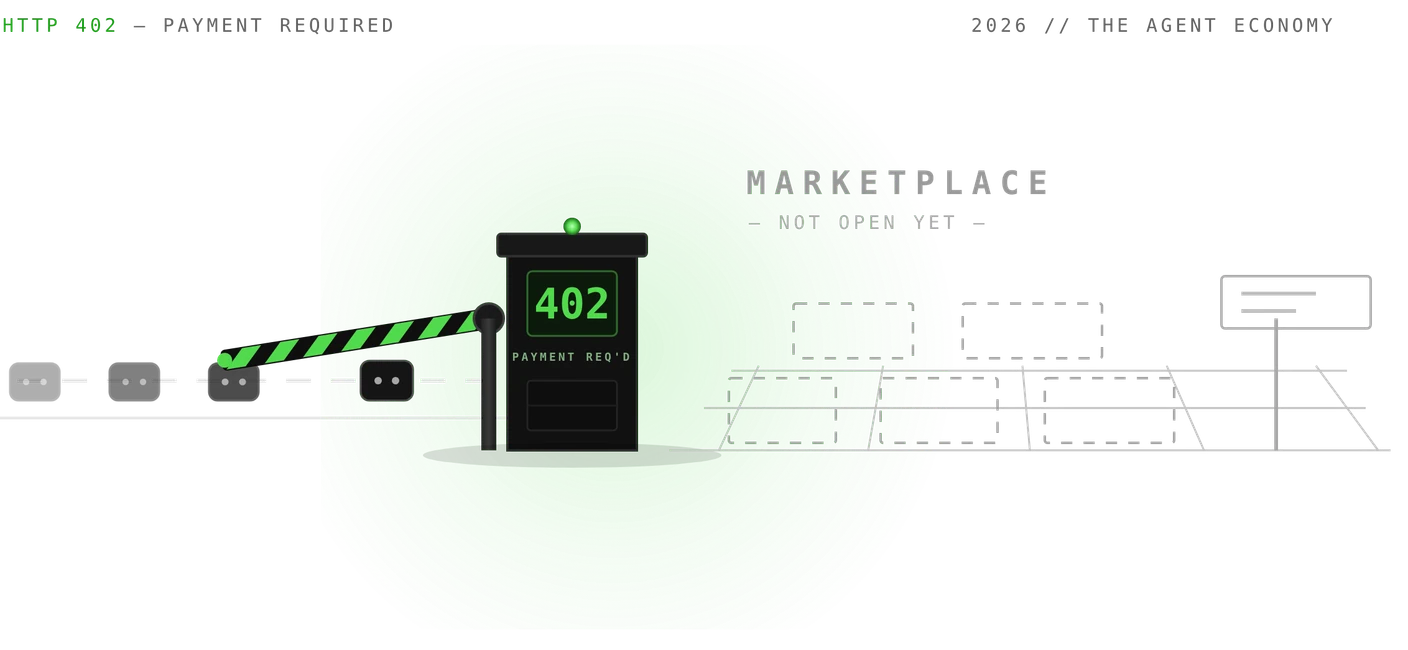
The rails are built. The 402 status code, dormant since the nineties, now has a foundation under it at the Linux Foundation, forty members including Visa, Mastercard, Stripe, Cloudflare, Google and AWS, and a spec you can implement in an afternoon. The technical question is solved.
The commercial question is not. Nobody has convincingly answered which agents will pay for which services, and most writing on the subject cheerfully assumes the answer is “all of them, for everything.”
–
TLDR: The rails for agent payments are built and the commercial case is not. Agents have no mental transaction cost, which is the thing that killed micropayments for thirty years, but they also have no loyalty, so commodity APIs get competed to marginal cost rather than monetised. Two tests decide who can charge: does agent traffic destroy your existing monetisation, and do you have anything that cannot be reproduced. In commerce today the money mostly flows the other way, from merchants to platforms. And in Europe the binding constraint is not the protocol. It is VAT rounding.
–
The usual analogy is the newspaper paywall. Everything on the early web was free, publishers eventually gated it, and it took a decade for readers to accept that. The claim is that this time acceptance will be faster, because software has no feelings about being charged.
That is half right. Agents genuinely have no mental transaction cost, which was the thing that killed micropayments for thirty years. But the analogy misses why sites will charge in the first place. Newspapers went paid because advertising underpaid. Sites will go paid for agents because their existing model does not survive a non-human visitor at all. It is not a story about acceptance. It is a story about a business model breaking.
That gives us the first test.
Test one: does agent traffic preserve or destroy the monetization?
Booking.com earns on the transaction. An agent that books a room is a perfectly good visitor, arguably a better one than a human who browses for forty minutes and leaves. Booking has no reason to charge for API access, and it will not. The value is captured downstream.
A newspaper earns on attention. An agent that reads the article and reports the gist to its user has consumed the entire cost of production and delivered exactly zero of the revenue. Same visit, opposite economics.
This is the line that actually matters, and it explains most of the confusion in the debate. Where downstream capture survives the agent, there is no reason for a payment protocol. Where it does not, the site has three options: charge, block, or die quietly.
The numbers on the second option are already brutal. Cloudflare’s crawl-to-refer ratios for the twenty-eight days to late June 2026: Google around five to one, Perplexity around 186 to one, OpenAI around 848 to one, Anthropic around 4,580 to one. Roughly ninety percent of AI crawler requests in May 2026 were extraction rather than anything that could produce a citation. TollBit found that publishers with licensing deals did not escape the trend either, with click-through rates falling from 8.8 percent in early 2025 to 1.33 percent by the end of it.
Cloudflare’s response is the most consequential thing happening in this space, and it is not a payment product in the way people imagine. Since 15 September 2026, training and agent crawlers are blocked by default on ad-supported pages for new domains. Cloudflare reports that sites on its network already return over a billion HTTP 402 responses to bots every day. That is not a market for agent payments. It is a toll booth, and the toll booth is the largest deployment of 402 in existence.
Test two: do you have anything worth paying for?
The first test tells you whether you need to charge. It does not tell you whether anyone will pay. For that you need pricing power, and here agents behave very differently from humans.
A human sticks with Google Maps out of habit and switching cost. An agent comparison-shops on every single call, has no loyalty, no brand attachment, and no procurement inertia. Agent demand is close to the perfectly rational customer economists keep assuming exists. That is not good news for suppliers. Under agent demand, commodity APIs get competed down toward marginal cost faster, not slower.
Which means the moat has to be something that cannot be reproduced. Three kinds hold up:
Proprietary sensing. Google Maps routing is not defensible because routing is hard. OSRM and Valhalla exist and are excellent. It is defensible because live traffic comes from a billion phones nobody else has. The algorithm is not the product. The sensor network is.
Legal exclusivity. Flight data is the cleanest case. Schedules are near-commodity. Live fares and inventory sit behind GDS and NDC distribution contracts, and the incumbents know exactly what that is worth. Lufthansa raised its distribution cost charge to between 18 and 23 euros per ticket depending on the GDS at the start of 2026, then raised it again in May. Amadeus is now pitching precomputed fare caching as the paid source of truth for AI agents. The gate is contractual, not technical, and contracts do not care how clever your agent is.
Latency and resolution. Weather shows the whole pattern inside one category. Base forecasts are effectively free because governments subsidise them, so agent-facing weather endpoints price at around a tenth of a cent per call and will keep falling. Hyperlocal nowcasting, high-resolution grids and long historical archives are gated and stay gated. Same domain, two price floors an order of magnitude apart.
The rule: agents pay for what cannot be reproduced, not for what is merely useful.
The money is mostly flowing the other way
Here is the part the hype misses. Ask who is actually moving meaningful money in agent commerce today and the answer is not agents paying merchants. It is merchants paying platforms.
OpenAI charges merchants four percent on completed Instant Checkout purchases, on top of Stripe’s processing. Perplexity funds a 42.5 million dollar pool that pays publishers eighty percent of Comet Plus revenue. Card networks are building agent rails so they stay in the flow rather than to enable new ones.
In travel, the interesting x402-shaped transaction is Booking paying the agent, not the agent paying Booking. That is affiliate economics with a machine-readable interface, and it means the rent moves to whoever controls demand. Which is three or four companies. The agent economy, at least on the commerce side, is shaping up to look considerably more like an app store than an open bazaar.
Meanwhile the actual agent-outbound spending is small and not entirely real. Coinbase’s headline figures were around 165 million x402 transactions and 69,000 active agents by late April 2026. Artemis, via CoinDesk in March, put real daily volume at roughly 28,000 dollars across about 131,000 transactions averaging twenty cents, with about half of all activity self-dealing or wash trading. A Visa and Artemis report in July found protocol totals dropping from about 135 million dollars to about 15 million once filtering heuristics were applied.
Strong standard adoption. Weak commercial adoption. Anyone writing about this owes their readers that distinction.
What agents do pay for
Strip out the noise and a real, boring, growing market remains:
- Marginal-cost infrastructure. Inference, sandboxes, rendering, browser automation. Every call costs the provider real money, so metering is natural and nobody has to be convinced of anything. Apify opened over twenty thousand of its actors to agent payments in July 2026.
- Gated data. Market feeds, KYC and credit signals, aviation, court records. Already per-call priced. x402 mainly deletes the procurement cycle for the long tail.
- Admission control. Charging as an anti-abuse mechanism rather than a revenue line. Rate-limit bypass, priority queue, proof of skin in the game. Cloudflare’s toll is this, and it is probably a bigger early market than content sales.
- Agent hiring agent. Specialist work a generalist cannot do, where the two parties have no other relationship.
Notice the pattern. x402’s real innovation is not payment. It is the absence of an account. No signup, no key, no contract, no procurement. It therefore wins precisely where the relationship is one-shot, anonymous and long-tail. Where a relationship persists, invoices and API keys work fine and will keep winning. Betting the whole agent economy on per-call micropayments is a category error.
Does MCP kill the aggregator?
The optimistic version says that once every supplier exposes MCP or WebMCP tools, agents route around Booking and Expedia directly.
I do not buy it. Booking’s moat was never the HTML. It is inventory contracts, price parity clauses, cancellation risk, and being the party you sue when the room does not exist. WebMCP disintermediates the interface layer. It does not disintermediate the clearing layer. What dies is SEO and the funnel. What survives is the balance sheet.
The evidence so far supports the boring view. OpenAI retired native Instant Checkout in March 2026 after roughly twelve Shopify merchants had gone live out of millions. Expedia rose around twelve percent on the news and Booking around eight. Agents also happen to prefer well-structured, API-first inventory, which is exactly what the aggregators already have. In the short run, the agentic web makes incumbents stronger.
And the long tail cannot self-serve. A twelve-room hotel in Kreuzberg is never going to run its own MCP server, spend controls, prompt-injection defence and dispute handling. Someone will do that for them, and that someone is a new intermediary wearing different clothes.
What has to exist first
APIs need to become 402-capable before any of this is testable. But the handshake is the trivial part. It is middleware. The unsolved layers are harder and less fun.
An agent needs the price and the response shape before it commits, or it cannot choose between three providers, which was the whole substitution mechanic. One data marketplace reported 1,183 agent probes, five settlements and eleven cents of revenue in a quarter. That is an evaluation problem, not a payment problem, and the industry keeps solving the wrong one. Removing the account also removes any way of knowing whether this agent is allowed to spend and whether a human sanctioned it, which is what AP2 mandates and know-your-agent work are for. A mandate can be perfectly signed and still match no real intent, because prompt injection attacks the decision, not the execution. Then there is what happens when you pay and the response is garbage: a human disputes the charge, an agent has no mechanism at all, and nobody owns refunds or escrow yet. And if an agent pays once for gated content, nothing stops it caching and redistributing, which makes per-call pricing for information leaky in a way per-call pricing for compute is not.
From where I sit in Berlin, though, the blocker is duller than any of that. Sub-cent machine-to-machine payments fall straight through VAT rounding conventions that assume cents: individually negligible, collectively a large and growing taxable base that is invisible to the tax authorities. Add mandatory e-invoicing and per-transaction compliance designed for something a thousand times larger, and the European constraint on machine micropayments turns out to be bookkeeping rather than blockchains. American coverage of this space ignores it almost entirely.
Where this lands
Agents will pay. They already do, for compute, for gated data, and for permission to exist on someone else’s infrastructure. The prices are small and the market is real.
But the interesting money in 2026 is not agents paying merchants. It is merchants paying platforms for agent attention, and infrastructure companies charging agents for access. The toll booth arrived before the marketplace.
If you are building for this, the useful question is not whether to adopt x402. It is which of the two tests you fail. If agent traffic destroys your monetization, you need a meter or a wall. If you have no pricing power, a meter will not save you and you should be worrying about substitution instead. Most people are shipping the payment integration and hoping the second problem does not apply to them.
It usually does.