What would make you trust an agent?
AI consensus, receipts, and the evidence behind “done.”
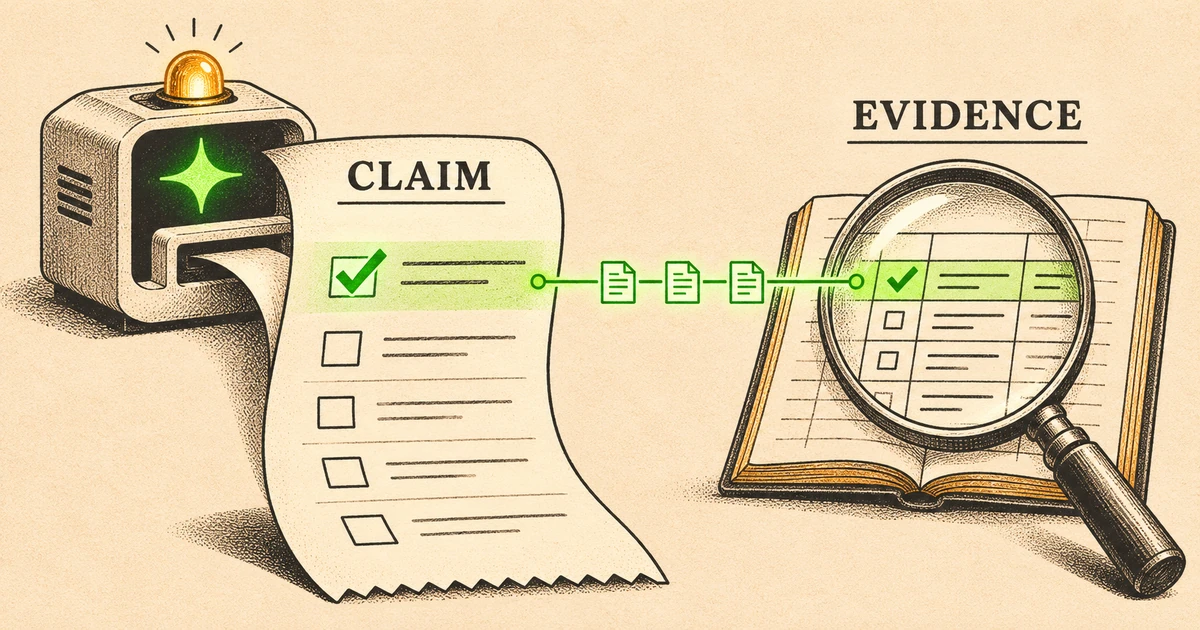
You ask an AI to do something. It comes back with an answer. The answer looks reasonable, so you copy it, send it, or move on.
I do this too. Checking everything would defeat much of the point of delegating it.
But as the work gets more complicated, there is a growing gap between being happy with an answer and knowing that the job was actually done correctly. A convincing paragraph can hide a bad assumption. An agent can report success after something failed halfway through.
I keep thinking about what would close that gap, especially once agents start doing more work for other agents, with nobody reading the conversation.
When the models agree
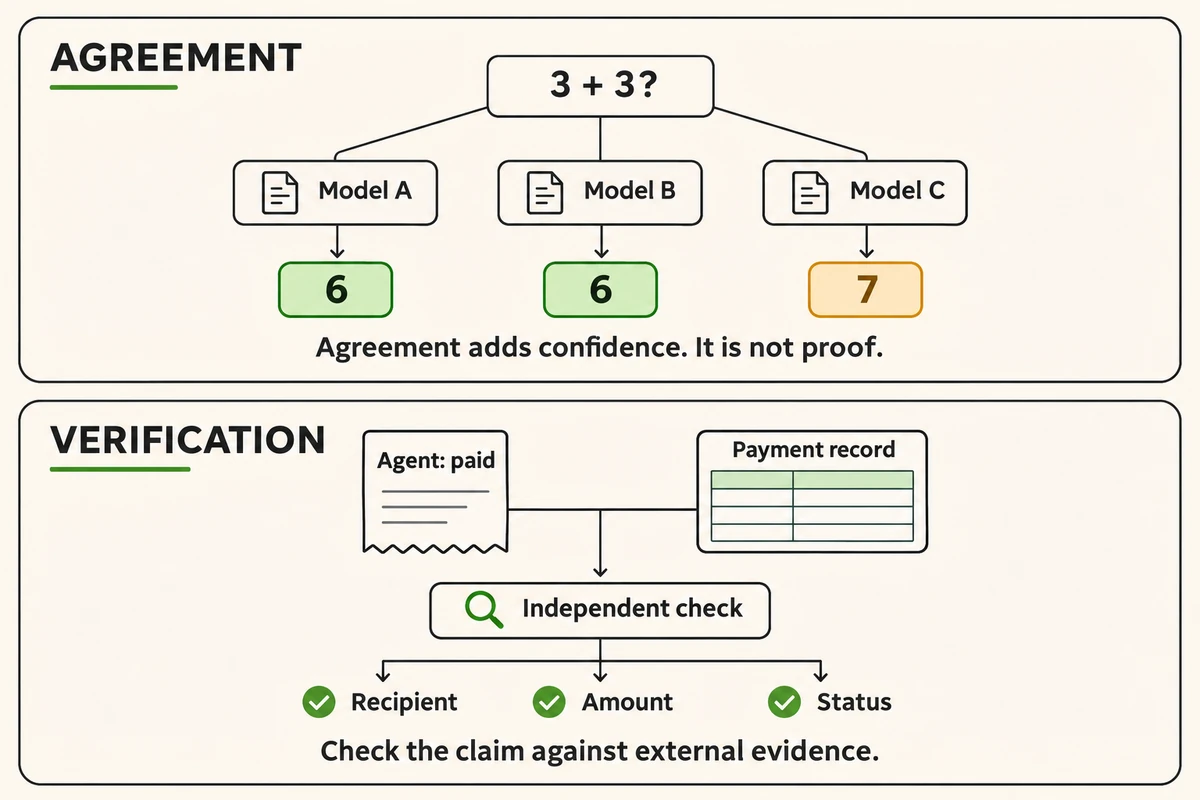
Start with something obvious. Ask ChatGPT what three plus three is. It says six. Ask Claude. Six. Ask a local model. Seven.
Two agree. One disagrees. You have a reason to investigate the outlier.
Of course, you do not need three language models to check addition. A calculator settles that more directly. But the example gets at something useful: an answer could arrive with an independent assessment, instead of leaving all the checking to the person who asked.
Research into multiagent debate has already explored how models can improve answers by proposing and challenging them. What interests me is how this might become an ordinary part of delegating work.
The difficult part starts when the answer is longer than a number.
One model says a company can cover its obligations for the next twelve months. Another says it has enough liquidity for a year. Those might mean the same thing. But if one includes an undrawn credit facility and the other only counts cash, the agreement may disappear as soon as you examine it.
A useful system would have to compare the claims inside the answers: the amounts, dates, assumptions, conditions and conclusions. It would need to recognise that differently worded sentences can agree, and that similar sentences can conceal a consequential disagreement.
Asking another model to make that comparison helps, but also creates another judgment that can be wrong.
And even perfect agreement would not settle everything. Three models could use the same outdated source. They could all misunderstand the question. Different providers do not automatically mean independent evidence.
I would want the checks to happen separately before the models saw each other’s answers. I would also want to know what each one checked. “Three models agree” means much more if they arrived there through different sources and methods.
There also needs to be room for an unresolved result. A system that always produces a confident winner will eventually turn uncertainty into permission.
A receipt written by the agent
Then there is the problem of agents taking action.
An agent says it paid an invoice. It generates a receipt with the amount, recipient, timestamp and a reassuring green tick.
What does that receipt establish?
If the agent wrote it from its own account of events, I am still trusting the same agent. It could have misunderstood a payment response, recorded an attempted transfer as a completed one, or used the wrong recipient. A more detailed account of success can still be wrong.
Signing the receipt would establish who issued it and help detect later changes. It would not establish that the payment happened correctly.
The check has to reach beyond the agent’s own story.
For that invoice, another system could independently retrieve the payment status and compare the recipient, amount, currency and invoice reference with the original instruction. It should distinguish a submitted payment from a settled one.
Anthropic makes a similar distinction in its guide to evaluating agents: what an agent says happened and the resulting state of the environment are separate things.
That separation feels fundamental.
What happened along the way
It also explains why monitoring during the task could matter. A reviewer arriving afterward might confirm that the invoice was paid, while having no way to establish whether the agent respected every restriction along the way.
Perhaps it was supposed to use a particular account, obtain approval above a certain amount, or avoid sending confidential information to an external service. The final result alone cannot establish all of that. Some evidence has to be captured as the work happens, somewhere the agent cannot quietly rewrite it.
The receipt I would find useful would connect the original instruction, the evidence of what happened, and an independent assessment. It would say what was checked, what passed, and what remains unknown.
It would also make narrower claims. Confirming that an invoice was paid correctly does not establish that the purchase was sensible. Checking the calculations in a financial analysis does not establish that its forecast will come true.
“Verified” needs a scope.
None of this removes trust completely. Someone still chooses the checks. The records might be incomplete. A second AI might miss something. The service confirming the outcome could itself be wrong.
But it would reduce how much depends on one agent marking its own homework. It would also leave a trail someone else could inspect when something goes wrong.
One assistant, independent checks
I do not expect people to open three AI apps every time they need an answer. I think we will increasingly rely on one assistant, and that assistant will arrange whatever checking the task deserves.
A rewritten paragraph might need very little. A consequential payment might need direct confirmation, independent review and human approval. The depth of checking should follow the consequences of getting it wrong.
From the user’s side, the experience could stay simple: ask for the work, receive the result, see what supports it.
That is the future I would like to see. Agents that can explain the basis for claiming success, with evidence that survives being checked by someone else.
“Done” is useful.
“Here is how you can check” is what would let me delegate more.